Case Study: Alleviating Court Stress & Increasing Inclusion in Guyana’s Criminal Justice System
Introduction
Guyana’s Ministry of Legal Affairs is spearheading a transformative restorative justice program aimed at reducing prison overcrowding and preventing people from becoming caught in a criminal cycle. By addressing minor offenses or disputes through non-custodial measures, the program aims to help reshape the criminal justice landscape by fostering community engagement and reducing reliance on jail sentences while prioritizing rehabilitation over punishment.
Guyana’s restorative justice legislation specifies the types of cases that can be addressed under restorative practices. These are minor offences subject to less than 3 years punishment, such as theft, larceny, and some forms of dispute. Coordinated by Guyana’s Restorative Justice Centre (RJC), restorative justice activities are designed to ameliorate key issues that currently contribute to the strain on Guyana’s courts and prisons: the criminal justice system’s overreliance on incarceration, and the overuse of pre-trial detention.
Restorative justice is an alternative approach to law enforcement that seeks to repair harm by providing opportunities for the victim and offenders—and sometimes other community members—to meet, discuss and address their needs in the aftermath of an offence, and agree on plans to right the situation.
Guyana’s restorative justice approach is now formally part of the country’s justice system and will eventually be implemented nationwide. This follows the November 2022 passage of a Restorative Justice Act and the initiation of a pilot project in Region 4 (on the East Coast of Demerara), which led to the establishment of the first RJC in Guyana, at Triumph, within the Regional Democratic Council (RDC) compound. As a result of a successful pilot project, the Ministry of Legal Affairs assumed total responsibility for the Restorative Justice Program through funding provided by the Inter- American Development Bank through the Support to the Criminal Justice System (SCJS) program.
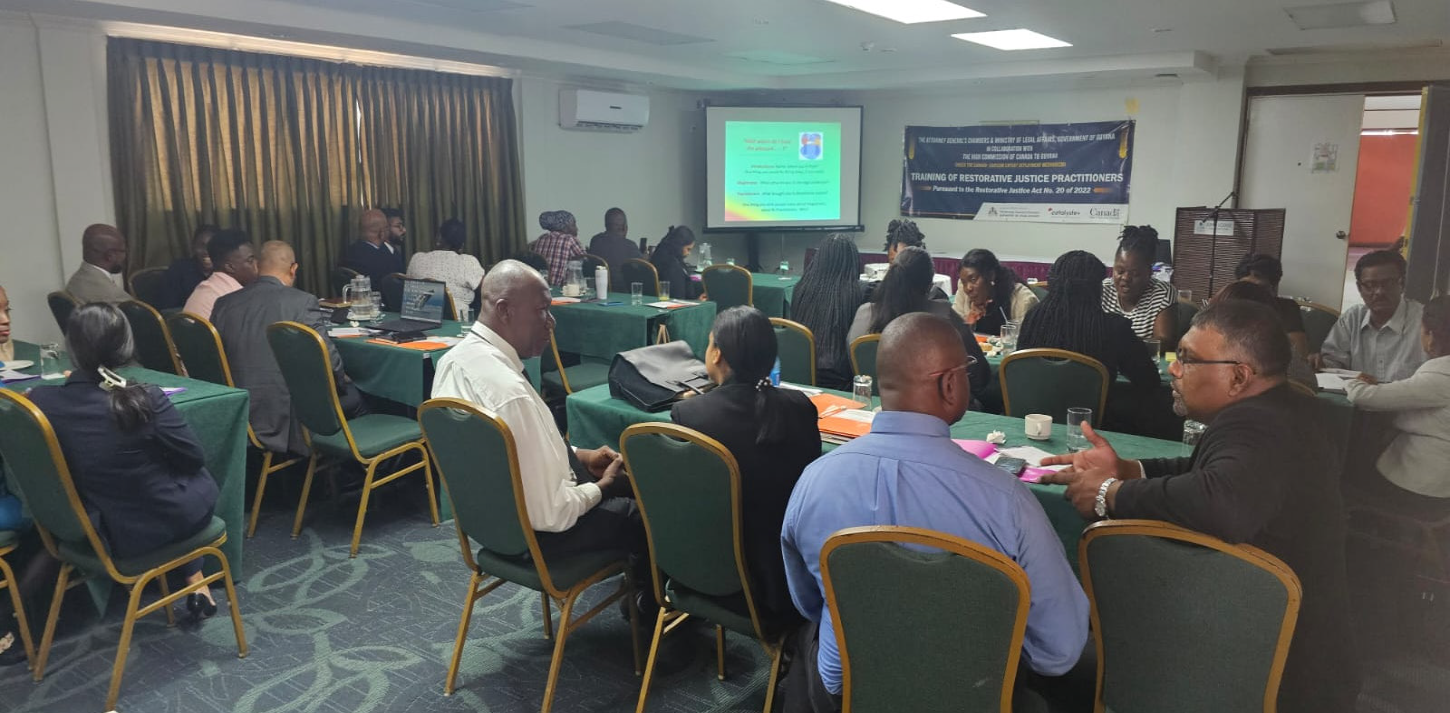
To achieve this, the government launched a series of training sessions for justice system stakeholders, including civil society organizations, and other institutions, such as educational institutions. Catalyste+ provided Canadian expertise to the new RJC through the CCEDM program. Between 2023 and 2024, three Catalyste+ Advisors (CA) assisted the RJC with start up activities: establishing standard operating procedures, providing training for the RJC and key public sector personnel, and working with the RJC to develop communication campaigns to raise public awareness of the restorative justice approach.
What Was the Situation
The increasing number of inmates in Guyana’s prisons and the overcrowded conditions they face have raised significant alarm within the nation. The World Prison Brief, released by the Institute of Crime and Justice Policy Research, indicates that as of January 2024, Guyana’s prison population rate stood at 288 per 100,000 people, which is considerably higher than the global average. Several Caribbean neighbours, including The Bahamas, Barbados, Jamaica, Trinidad and Tobago, and Suriname, also exhibit similarly elevated rates.
Further, with an overcrowding rate of 151% in September 2022, Guyana’s prison population far exceeds the country’s capacity to house them.
According to Mr. William Orrin Boston, Director of the RJC, in Guyana’s case two specific problems are contributing to that situation: (i) the over reliance by the criminal justice system on custodial sentences; and (ii) the overuse of pre-trial detention. “Generally, our justice system works through traditional modalities”, said Mr. Boston. “Historically, it’s a very penal system… people feel you’ve got to see the punishment to feel that justice was done”, he added. Because everything emanated from and through the courts, they grew overwhelmed, as existing alternative solution like probation and community service orders were minimally used, said Mr. Boston.
In Guyana, this tendency towards strict law enforcement accompanied by an overreliance on custodial sentences is a problem that results in significant increases in prison population by locking up people charged with petty and nonviolent offences.
Retired Police Commissioner for Guyana, Mr. Seelall Persaud, worked for 33 years in law enforcement in Guyana. He is regarded by some as the “father” of Guyana’s restorative justice program, and explains that although Guyanese judges have long had the option of both probation orders and community service orders as alternatives to imprisonment, insufficient institutional capacity prevented their use. “The problem is that trying to put people on probation or suspended sentences never really worked because there were not enough staff—such as probation officers—to provide supervision.
The system’s overuse of pre-trial detention is another pressure point. This should be a rare and/or limited practice in a country where the accused have a right to the presumption of innocence. However, for several reasons— including the frequent inability of offenders to raise funds for bail—this has become the default measure in Guyana.
Quite simply, prior to the introduction of restorative justice, Guyana’s criminal justice system lacked formal alternatives to solving disputes that would lessen prison overcrowding; alternatives where the victims and offenders could meet and agree on restitution or where youth in conflict with the law (due to minor offenses) could be diverted from the criminal justice system.
Mr. Persaud’s years of law enforcement experience and study of criminology led him to understand that while the conventional system of punishment often failed, it could be improved with the addition of a social approach and community collaboration to address crime. As Police Commissioner he had some success working with community leaders such as pastors, educators and business people, to address crime in violent and crime prone communities, reducing youth crime rates by keeping kids in school, offering vocational skills training, jobs, and reaching out to parents during church services.
After his retirement and Guyana’s 2020 election, Mr. Persaud reached out to the country’s new Attorney General, who was trying to breathe life into an earlier Restorative Justice Act by passing new legislation in 2022 and utilizing the remainder of restorative justice funding received from the Inter-American Bank’s SCJS program, which was supposed to end in 2022 but was extended to March 2025. Acting as the first head of the nascent RJC, Mr. Persaud helped prepare a plan of action to make the new centre functional. The plan included work on training, communication and standard operating procedures.
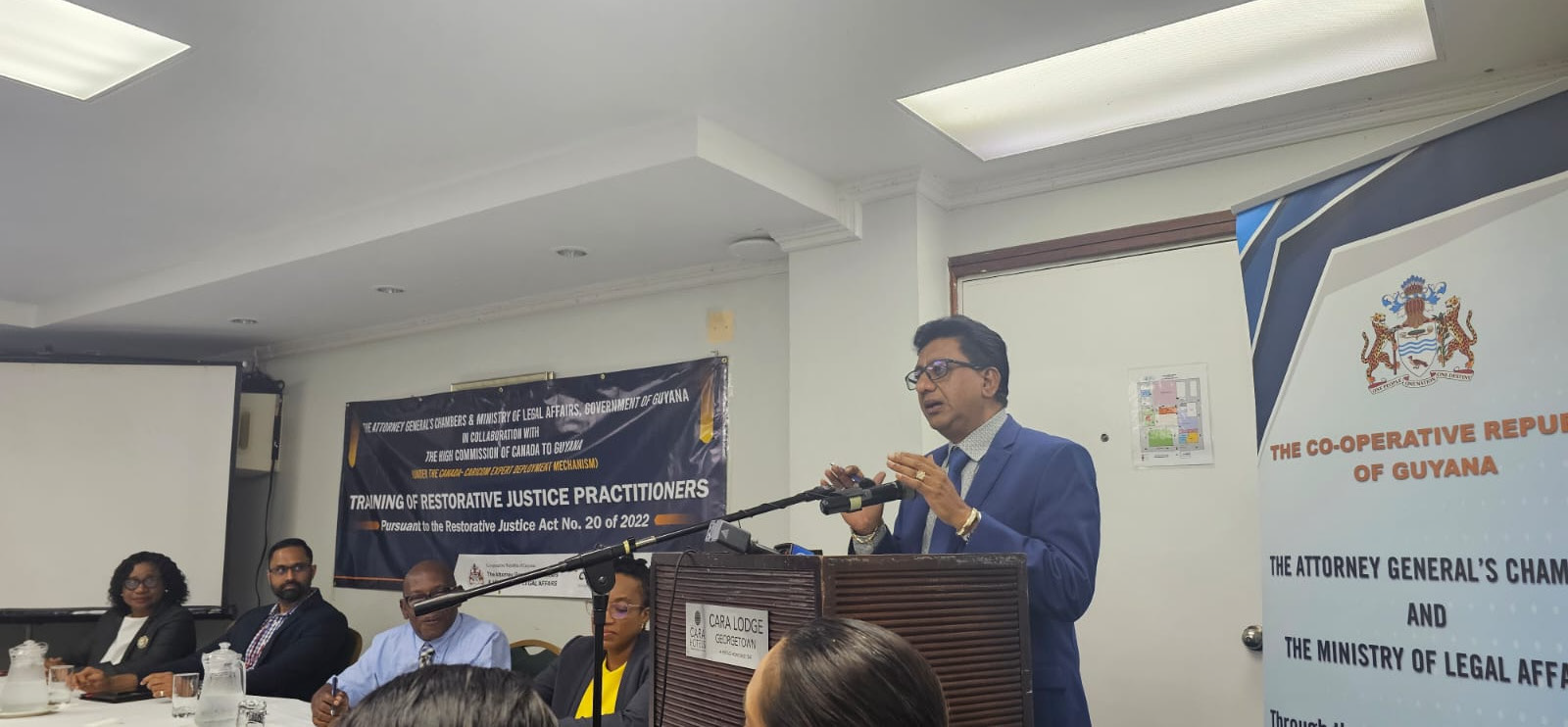
Through a chance encounter with a representative of the Canadian High Commission at an event hosted by the Office of the Attorney General, he was able to learn about the services offered by the CCEDM project and quickly used that project to recruit the three CAs with the skills needed to help fully launch the new RJC, as laid out in the plan of action.
How Catalyste+ Helped Frame a Solution
In mid-2023, the RJC and the Ministry set a goal of having ten teams of regional restorative justice officers working in the Magistrate courts in each of Guyana’s 10 regions.
Between late 2023 and December 2024, the three different CCEDM CAs provided online professional services and travelled to Guyana to assist the RJC in establishing standard operating procedures, provide training for the RJC and key public sector personnel, and help the RJC in developing communication campaigns to raise public awareness of the restorative justice approach.
Technical CA Alan Howard, a licensed mediator in restorative justice based in Perth, Ontario, entered the picture in Fall 2023, when the RJC was “established on paper” but still beginning its actual set up in “form, function and personnel”. The RJC needed someone to train its first cadre of restorative justice practitioners as well as key stakeholders such as educators, welfare officers, prison officials and magistrates in restorative justice principles and practices.
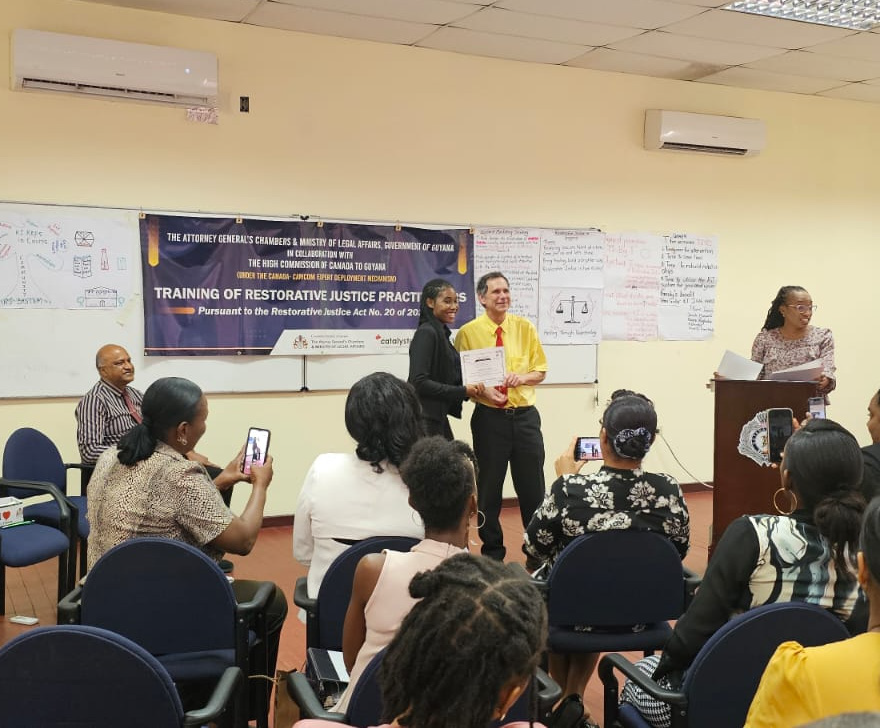
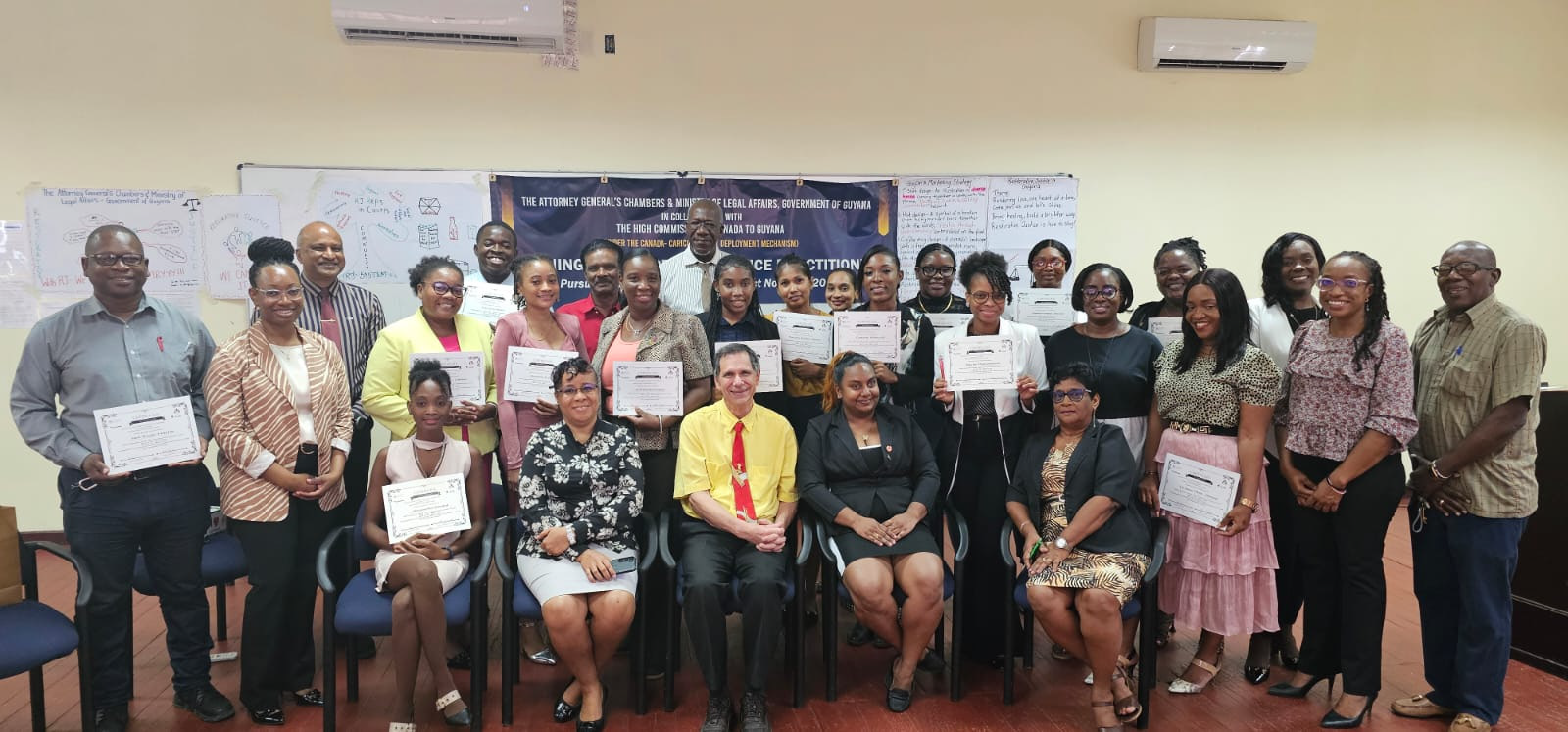
After initial virtual discussions to scope out the work ahead, Mr. Howard travelled twice to Guyana. First in March 2024 when he spent two weeks training both female (16) and male (6) practitioners. He returned in late 2024 to train a larger group of staff, managers and various stakeholders.
In addition to his experience with Canadian Indigenous communities, and his background in education and counselling psychology, Mr. Howard brought his many years of experience as a restorative justice practitioner in a local volunteer program with Lanark County Community Justice.
Lanark County Community Justice is a non-profit organization in Ontario, Canada, that promotes and provides restorative practices to repair harm from conflict and crime, build community, and strengthen relationships. They offer programs and services free to the community, focusing on restorative justice approaches, particularly for youth and families.
He credits the generosity of the Lanark County Community Justice centre with helping him to transfer both the theoretical knowledge and the administrative expertise needed to manage a case from beginning to end. The Perth centre authorized access to an off-the-shelf set of resources from the Perth, Ontario program to Guyana’s new restorative justice system, which enabled the trainee practitioners to participate in role playing scenarios based on actual experience, and to use a set of administrative paperwork to organize case files.
“There’s a file set that applies to every case that practitioners must be able to navigate and apply. This covers participant responses, interviews, police reports, etc. … in short everything it takes to process and manage a case. It’s a very structured and formalized process that reaches formal outcomes in a very informal and comfortable ways”, said Mr. Howard.
Communications technical CA, Joanne John, also entered her assignment with a background in restorative justice. Ms. John, who retired in 2017 from a long career covering both internal and external communications for a variety of Canadian federal departments, was able to liaise with restorative justice program administrators at Corrections Canada, where she had worked previously, to gather useful information. “As soon as I decided to put my name in the hat for this assignment, I consulted with former colleagues involved in the start up of restorative justice in Canada and I went back to documents for a literature review”, said Ms. John.
After some virtual meetings to plan out the assignment, she landed in Georgetown, Guyana in February 2024, where she worked at the temporary headquarters of the RJC alongside Director Mr. Boston and his small staff to understand the key players and the environment. Her first meeting was with the Attorney General’s office.
“[The Attorney General] laid out very clearly what his expectations were, which was to be sure that the stakeholders would be well informed and ‘in the tent’. He was also concerned about the organization’s image”, said Ms. John. Ms. John also worked alongside the Ministry’s public relations section staff, who understood how public relations and communications function on the ground and helped her design an action plan for engagement with a variety of target audiences.
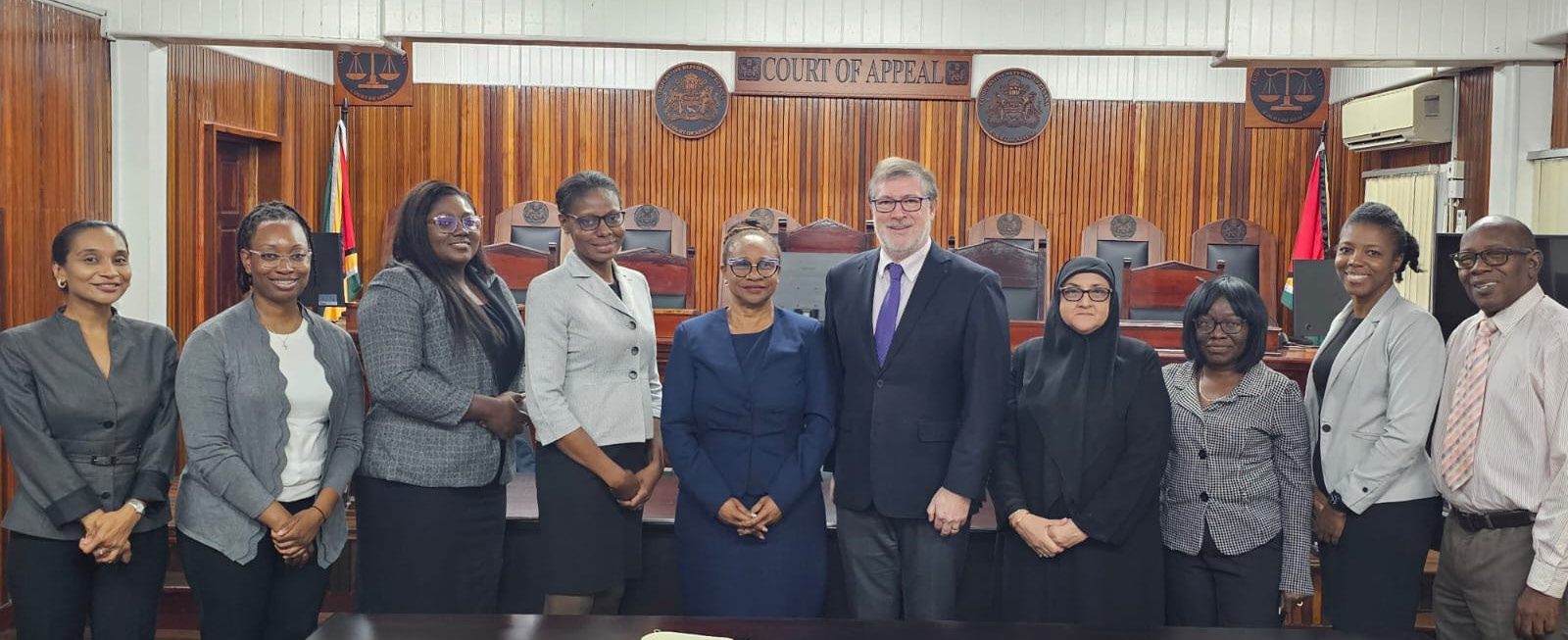
Mr. Simon Coakeley, a retired Assistant Deputy Minister with a legal and management background in Canada’s public service, is the CCEDM CA who led the development of Standard Operating Procedures for the RJC. His assignment also began virtually in late 2023, and involved a two week trip to Guyana in May 2024 to develop procedural guidelines for implementing the 2022 restorative justice act.
“It was a very well written piece of legislation, with a lot of thinking behind it and was quite easy to look at and understand what it was trying to do”, said Mr. Coakeley. “There’s pieces in the legislation that are high-level statements, so in order to make that statement happen, you need regulations or internal policies and procedures”, he explained. During his two weeks in the country, Mr. Coakeley met with both the RJC’s former Director, Mr. Persaud, and the current Director, Mr. Boston. He quickly drafted a list of high-level steps that could be used as a framework for standard operating procedures and spent the rest of his time meeting with justice sector stakeholders at various levels to refine a set of SoPs and present them to the Director on the last day of his assignment.
Results and Changes Observed
“All three CCEDM advisors have served us in tangible and empowering ways, giving us a solid platform from which to launch the restorative justice program”, said the Centre’s Director Mr. Boston. Advisor Alan Howard provided training to certify his “small but mighty” team as restorative justice practitioners.
CA Joanne John left the Centre with a full structure for a communications strategy to raise public awareness of the major paradigm shift that restorative justice represents. “Some of the communications tools have served as our terms of reference for recruiting new officers to work in our restorative justice centres”, said Mr. Boston. “The standard operating procedures that Advisor Simon Coakeley helped us develop from the restorative justice act are a tool that we are using to develop our functional systems and forms, [and which] enable the new restorative justice system to get off the ground”, he adds.
Mr. Boston said that he expects restorative justice centres will be opened in each of Guyana’s 10 regions by the end of 2025. As of April 2025, four centres in four regions have been established. In March 2025, the regional RJC in region 4 based in Triumph, East Coast Demerara, which services five different magistrates’ courts, took on Guyana’s first five restorative justice cases, referred from Magistrate court level.
Mr. Robert Bourne, a Restorative Justice Officer, trained by CCEDM CA Mr. Howard, is handling the first case referred to restorative justice by the courts. Mr. Bourne said he is proud to be playing a role as a practioner in Guyana’s criminal justice system. “We’re not there to replace the magistrate”, he explained, “but to render our expertise to help clear the backlog of cases and restore harmony in Guyanese society”.
According to Mr. Bourne, this is a verbal assault case. Following completion of the court hearing session, Mr. Bourne contacted both the victim and the wrongdoer and had them complete the consent forms to commence the restorative justice process, which will follow the formal procedures outlined under the newly defined SoPs and hopefully reach a settlement satisfactory to both parties.
As of early May 2025, this newly referred case is still in process and may or may not result in a satisfactory resolution. However, it is an auspicious start which indicates that the courts and members of Guyanese society are buying into the new restorative justice alternative and that the newly trained practitioners and community leaders are operating with a high level of confidence in following the SoPs in their initial attempts in processing cases referred by the court.
According to the SoPs, the next steps in the process would include separate pre- conference conversations with both the victim and the wrongdoer, where scripted questions would review what happened and explore each party’s desired outcomes for the restorative justice process, and assess whether the harm could be repaired. This would be followed by a joint conference, or conferences with the two parties and their supporters, where they seek common ground. The process would continue from there until the restorative justice officer submits a report to the RJC Director and the court.
Director Mr. Boston of the RJC is justifiably proud at this auspicious start towards alternative justice practices in Guyana. “I have a small bunch but they’re raring to go!”, he concludes.
Next Steps
According to Mr. Boston there are plans to staff an additional six restorative justice offices to serve the magistrates courts in the six remaining regions this year. This will involve additional recruitment and training/certification of new restorative justice officers. CCEDM CA Alan Howard is expected to return to Guyana soon for additional training sessions, explained Mr. Boston. This training will be in addition to support that the RJC can access through the International Institute for Restorative Practices.
There will be more referrals from the court systems and the roster of cases going forward through the restorative justice process in Guyana will increase as the courts and the public grow accustomed to the new restorative justice practices.
Finally, Mr. Boston anticipates that in the years ahead Guyana will need to expand the number of restorative justice centres serving each region – having one regional RJC located in a central spot is just a beginning.
Retired Police Commissioner, Mr. Persaud, now volunteers as an expert on the Restorative Justice Council, a policy body. He predicts that the RJC will soon be flooded with case referrals from the courts, and that both prison overcrowding and the level of violence in Guyana will reduce as more and more cases are referred to Guyana’s new restorative justice stream.
“The engagement of restorative justice leaders will strengthen Guyana’s social fabric at the community level because these community leaders – pastors, educators, business people – will encounter youth and others daily, and redirect them from needing to resort to muggings, house breaking [and] theft. Even domestic violence rates will decrease because people will be able to better access community support services.”