Apiculture Mini Series Part 2: Building a New Generation of Environmental Leaders in Colombia
This is Part 2 of 3 of our Apiculture Mini Series. Check out our other stories:
Apiculture Mini Series Part 1: Empowering Rural Women Beekeepers Across Bolivia
Apiculture Mini Series Part 3: Buzzing Ahead in Honduras
Context
Despite its small size, the honeybee plays a crucial role in Earth’s ecosystem -pollinating crops, producing honey, and reflecting the health of its environment. In countries like Colombia, it also carries economic weight, supporting livelihoods for rural women and men through apiculture. Yet as the climate changes, the future of beekeeping – and those who depend on it – has become increasingly uncertain.
Beekeeping was common in Colombia during the 1980s but declined sharply in the years that followed. A widespread outbreak of Varroa, a parasitic mite that attacks honeybees, destroyed many hives, leaving beekeepers discouraged. In San Carlos, Colombia where beekeeping was not a longstanding local tradition, knowledge and skills largely disappeared.
By the early 2010s, however, apiculture began to re-emerge as a practical strategy for rebuilding livelihoods. Decades of conflict between the government and the Revolutionary Armed Forces of Colombia (FARC) had displaced communities, forcing families to abandon homes, land, and livelihoods. Others were displaced by climate-related disasters, with the challenges of returning further compounded by the ongoing insecurity. As conditions slowly improved and communities prepared to return, particularly following the peace agreement between the government and the FARC, beekeeping offered both a source of income and a meaningful way to reconnect with the land.
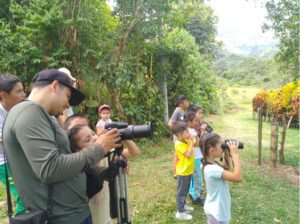
Students and AFRICOLMENAS member Juan Pablo García Atehortúa birdwatching.
The Asociación de Apicultores Biológicos del Municipio de San Carlos (AFRICOLMENAS) was formed in 2013 as part of this recovery process, just prior to the signing of the peace agreement. With support from the National Training Service (SENA), local women and men in the association received training in sustainable beekeeping. The association began with a community apiary of 10 hives shared among 30 families, gradually developing skills to produce honey and other products for national markets. For several years, the association thrived, expanded to two community apiaries, and supported the local families.
La Niña is a climate pattern that occurs when ocean temperatures in the central and eastern Pacific are cooler than usual. This affects weather around the world. In Colombia, La Niña typically brings intense rainfall, stronger winds, and a higher risk of flooding and landslides.
However, in 2021, the La Niña phenomenon occurred. For three years, relentless rainfall, violent winds, and electrical discharges from nearby hydroelectric plants affected the region. The bees suffered from the extreme weather, causing honey production to halt. The families who had once relied on the hives no longer had a reliable source of income.
“From this crisis, we were faced with the question of what to do”, shares AFRICOLMENAS member and Project Coordinator Carolina Duque Guzmán. “We started to think about the next generation and decided we needed an educational project that allowed us to teach the children about beekeeping, but also about environmental awareness.”
Turning Knowledge into Education
As experienced beekeepers, AFRICOLMENAS had developed extensive knowledge in apiculture, climate change, and conservation, however, turning that expertise into age-appropriate lessons for children required a very different skill set.
That’s when AFRICOLMENAS connected with Catalyste+.
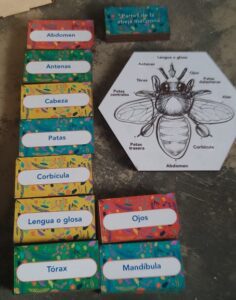
The interactive bee-body puzzle developed by Carolina and Catalyste+ Advisor Barb.
Over three months, Catalyste+ Advisor Barb Shackel-Hardman, an expert in instructional design, worked closely with AFRICOLMENAS member and Project Coordinator Carolina to develop a six- module course for elementary grade children in San Carlos. As part of their collaboration, Barb introduced Carolina to key pedagogical concepts, including the importance of learning throughplay. Together, they identified learning objectives, structured the course content, and adapted the material to align with Colombia’s required curriculum. Furthermore, Carolina and Barb incorporated themes of inclusivity into the course so that every student, girls and boys alike, could envision themselves as future beekeepers and environmental stewards.
To reinforce core concepts from the social and natural sciences and keep students actively engaged, Barb and Carolina developed a series of interactive learning tools. These include a bee-bodypuzzle to help students identify anatomical parts and their functions, a hive-nest puzzle illustrating the structure and purpose of each chamber, and a memory game introducing the different roles bees play within a colony. These hands-on activities were designed to make learning both meaningful and enjoyable for students.
The collaboration between AFRICOLMENAS and Catalyste+ resulted in six well-designed modules covering the following topics:
- Communication and Memory: the various ways in which bees communicate with one another, and how their memories work.
- Climate Crisis: climate change and its impact on the region.
- Basic Concepts of Meliponiculture and Beekeeping: the principles of meliponiculture (the practice of cultivating stingless bees) as well as general beekeeping.
- Democracy: how bees make decisions collectively and democratically.
- Pollinators and Dispersers: the role pollinators, like bees, and seed dispersers, like birds and mammals, play in maintaining healthy ecosystems.
- Final Mapping: the parts of the bee’s body and its evolutionary traits.
Bringing the Course to Life
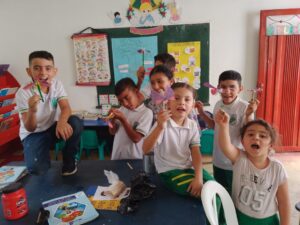
After designing the course, Carolina and other AFRICOLMENAS members, with support from local allies including APAEC (the Association of Parents and Adoptees in Colombia), developed the didactic materials and implemented the program at a rural education center in Dosquebradas, a community near San Carlos. Over six months, they met weekly with 12 sixth-grade students, using hands-on modules to spark curiosity and foster a genuine connection with bees and the natural environment.
“The creative, and context-specific learning connected [the students] with their environment,” shared Carolina. “They gained knowledge of basic concepts like biodiversity, pollination, and conservation.”
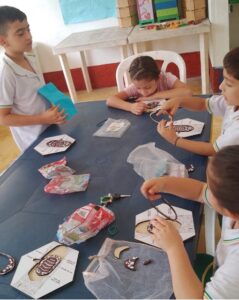
Students assembling the buildable bee nest during the course.
One day, a student approached Carolina with a handful of bees he had found while helping his grandmother cut down trees. He wanted help identifying the species, but with over 500 bee species in Colombia, Carolina wasn’t sure what type of bee it was.
Instead of offering a quick answer, she saw a valuable teaching moment. Drawing on the pedagogical principles recommended by Catalyste+ Advisor Barb, she encouraged the student to explore the question himself.
With his classmates’ help, the student designed a simple trap to observe the bees and study their behavior. Although the bees eventually flew away, the experience had a lasting impact. The children weren’t just absorbing information; they were learning to ask questions, experiment, and engage with the natural world.
A Shift in Thinking
This kind of learning extended beyond the classroom. Carolina and the AFRICOLMENAS team noticed that students began applying their new knowledge to everyday decisions in their communities. While older generations of farmers often prioritized inexpensive or practical choices – such as cutting down trees to expand their farms without considering the ecological impact – the children were beginning to see things differently. They understood that trees provide a habitat for bees and birds and are therefore essential to their environment.
In many ways, the course achieved exactly what AFRICOLMENAS had hoped for. By translating their deep knowledge of apiculture, climate change, and environmental conservation into structured, engaging lessons, they were able to reach the next generation in a meaningful way. The course not only sparked curiosity and environmental awareness, but also laid the groundwork for a more resilient and sustainable community – one where future beekeepers are better prepared to navigate the challenges of a changing climate.
“Learning the basics of meliponiculture helped [the children] develop environmental awareness, consider sustainable economic alternatives, and opened up opportunities to see themselves as scientific researchers of species in their territory”, added Carolina.
Growth Through Teaching
The course wasn’t just transformative for the students; it had a significant impact on Carolina as well. Through the process of developing and implementing the course, she strengthened her leadership, project management, and decision-making skills. As a result, she gained greater confidence in her abilities as an educator, environmentalist, and community leader.
“My self-esteem improved through the opportunity to lead, structure, and develop an educational project we had long dreamed of creating with the association”, shares Carolina.
Importantly, this growth doesn’t stop with Carolina; it’s part of a long-term generational relay of knowledge.
“The countryside is running out of hands,” Carolina explains. “If we do not educate children, this will not change. Many young people leave to study or work in the cities, and if they don’t know there are opportunities in agriculture, they won’t return. But through this project, children are gaining knowledge about ecosystem conservation and the importance of bee pollinators. They want to keep their own bees on their farms and continue learning about the subject.”
Looking ahead, Carolina plans to involve more women from AFRICOLMENAS in the creation of future educational materials. By doing so, she hopes to create new opportunities for women to engage in environmental education and leadership,while simultaneously nurturing a new generation of rural youth who can carry forward the work of sustainable agriculture and conservation.
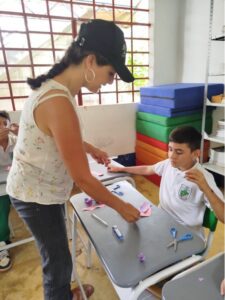
Carolina explaining metamorphosis to a student.
Conclusion
Through their partnership with Catalyste+, AFRICOLMENAS turned a moment of crisis into an opportunity to grow stronger together. What began as a response to environmental and economic setbacks has become an inspiring educational initiative that connects children with nature and equips community leaders like Carolina with new tools to share their knowledge. By engaging both women and youth, Catalyste+ and AFRICOLMENAS are fostering a more inclusive and sustainable future for rural Colombia.
Together, AFRICOLMENAS and Catalyste+ are shaping lasting change, inspiring the next generation to protect the bees and the ecosystems they rely on. Like the honeybee itself, this small initiative is having a big effect on its environment and the communities that depend on it.
“Our future depends on the presence of rural children,” reflects Carolina. “We must focus our energy on educating the children of Colombia with social and environmental awareness, and an understanding of sustainability.”
Acknowledgement
Catalyste+ would like to thank Brianna Marshall for leading the creation of this impact story, as well as Claudia Aparicio, Natalia Naranjo, Alejandra Lopez Ramirez, Carolina Duque Guzmán, and Barb Shackel-Hardman whose valuable inputs contributed to this publication.